I am currently living in Regina, Saskatchewan which is situated on the territories of the nêhiyawak, Anihšināpēk, Dakota, Lakota, and Nakoda, and the homeland of the Métis/Michif Nation. Regina is located on Treaty 4 lands with a presence in Treaty 6.
Truth & Reconciliation Children’s Books:
Links to purchase each book along with author biographies are listed here:
Usually, the student who is showing the worst behavior is the student who is in need of the most one-on-one time, support, connection, and healing. Back in the day, the strap was used when a student acted out or did not listen to the teacher, the strap has been proven to work eighty percent of the time as it embedded fear into the students that they would be receiving this abuse if they ever repeated the same actions. However, abuse is never the answer. What about the other twenty percent of students? What about kindness? Understanding? This way of discipline was beyond wrong, no matter what the teacher’s goals were within their own classroom. Teachers were possibly adding to the cycle of abuse one had endured. New ways of aiding a student when they act out are to listen, understand, being a shoulder for them to cry on, and being someone they can trust. Restorative justice is beyond successful within schools.
Restorative justice is a way of ending the cycle. Students at home may experience abuse, extreme consequences, etc. When they go to school they may act out causing the teacher to react badly by sending them to the office, yelling, detention, etc., however, this turns into a horrendous cycle for the student. Abuse, yelling, being locked in their room at home, and then yelling, being sent to the principal, and being suspended for bad behavior sends them right back to their home environment. The student is never shown proper support and never once asked “what is going on in your personal life? How can I offer you support?”. By using restorative justice within the classroom setting, you are ending the cycle.
Rather than teaching children the acts of kindness and friendship through storybooks, allow for students to learn about kindness, strength, and determination through real-life speeches and acts. Students are not able to connect to storybooks and television shows the way they are able to feel and understand real-life humans who have lived and experienced racism and heartbreak. We need to teach more than kindness, we need to teach human rights and help students understand how they can make a positive change and implement positivity and change into their own lives through others’ experiences.
My Two Personal Connections:
I used to act out in school, especially between grades six to ten. It was a non-stop fight with my teachers, when they told me to sit down in my desk, I would sit on top of the table, if they told me to do something, I would keep my binder closed. It was a silent cry for support, kindness, and understanding. Teachers who would send me to the office or call my parents were the teachers who I continued to rebel against and I would send worse behavior their way as the days passed. The teachers who listened to me, showed me kindness and gave no response to me when I acted out, were the ones who got the best version of me. The way you treat your students is the most important part of teaching, if you cannot listen to them, why would they listen to you.
Dr. Suess and Robert Munsch’s stories were very popular in my household because their stories were how I personally learned to read. They were easy to read, intriguing, colourful, and always cute. However, other than friendship, kindness, and how to deal with someone who was acting out, these books did not hold much of anything else. Characters portyed in the books were not children of colour or different cultures, they always acted the same and always had parents caring for them, never grandparents or other guardians. I personally feel like I would have benefited from other stories that held more dynamic and guidance into differing topics.
My One Question Based on the Reading:
How can we ensure that we are covering all cultures, beliefs, and portions of history in a beneficial way that is not only respectful but connected to the curriculum? As well as portraying proper and concise information based on each topic.
The vast majority of education, curriculum, and resources used within the classroom are of white possession. For proper learning and understanding to be reached within the classroom new resources, ways of knowing, and different cultures must be introduced otherwise students are not reaching their highest potential of world knowledge and understanding.
Whether or not the classroom is ‘owned’ by the Teacher OR a place that can foster knowledge and create relationships is one hundred percent decided by the educator themselves. The teacher’s main focus is to be within the classroom to teach, but the next level of a relationship with students is to be open and honest so that you and your classroom can be a safe place for students.
Our most commonly visited places, alongside the places we spend the most time in, aid in the creation of our identity. If students are spending six hours a day, five days a week within your classroom the educator along with the classroom space that has been created will become a large, and vital part of a students’ identity. It is up to the teacher to provide proper resources and allow for students to make this a positive part of their daily life and not negative as many students have experienced at some point.
My Two Personal Connections:
When the article explains class relationships I began to think about my own teacher-student relationships. I grew up in a small town that had one kindergarten to grade 12 school, and our classes were always two different grade levels combined since my grade usually had between five to eight students within it. This allowed for teachers to know everything about us, while we got to also learn about them. Then, when I came to University it was the exact opposite. Classrooms were now packed, students did not know each other, and the Professors (usually) do not even learn your name let alone your life story and how you are processing information.
Boundaries have always been given to me whether at school or on the acreage. Either you weren’t allowed on the train tracks because they were out of school limits (and also dangerous to play on) or you were not allowed to be up past 8:30pm on a school night. Wherever you go there are always boundaries, however, these vary from place to place. You may go to a friend’s house where all the doors are open and you are free to roam, or you could visit your grandparents where the doors would all be shut and you could only be in the kitchen or living room. It is very personal to think about the boundaries that you not only set for yourself but the boundaries that have been set for you as you have grown up.
My One Question Based on the Reading:
If reading allows for one to “read the world” then how can we as future educators implement proper resources that not only ensure that all cultures and beliefs are covered but to help students understand that being different is powerful and welcome within the classroom?
Through having access to something as simple as plant-based items within your classroom, is a way of showing inclusivity and understanding to your students. This is a prime example of how simple it can be to ensure that your students feel and understand that they are exactly where they belong, and their beliefs and values will be taken seriously and understood by the teacher. By educating your students about differing cultures, beliefs, and values, you are spreading knowledge and inclusivity for generations to come. A simple act of understanding and learning leads to change.
Communication means more than just having a conversation with another person. Communication is learning phrases of your student’s native language while they learn yours. Communication is understanding what holidays your students celebrate and what types of foods and clothing are a necessity during these times. Communication is watching movies, listening to music, and reading stories created by different people from all around the world. Communication is the recipe for success and lifelong learning.
Students’ needs will change and evolve all the time, our teaching strategies and thoughts within our classrooms will need to do the same. Through each year we will educate new students, meaning we will be met with new life stories, expectations, and needs. We need to adapt to these expectations and needs to ensure our classrooms are gender-friendly, anti-racist, and inclusive.
My Two Personal Connections:
When I was in elementary/middle school, we had a student in our class who had a disability. However, we were never told why she was treated differently from the rest of us. She was given different opportunities, rules, etc., and always had the rest of us questioning why she was given “more” than us. In conclusion, if our teachers would have explained to us that this was the method for allowing for her to feel included/creating a “fair” environment, both she and the rest of us would have benefitted from this conversation. Rather, we were left in the dark on the topic, jumped to conclusions, and never fully understood why these methods were chosen.
My classroom experiences (other than the experience written about above) highly lacked diversity and learning about diversity as well. We were never exposed to new holidays, different cultures, different beliefs, upbringings, etc. Gender was never a topic, nor was anything of differentiation. Which in my opinion was a lost opportunity, I am grateful to be learning about these topics now, but I would have greatly benefited from learning about these topics twenty years ago.
My One Question Based on the Reading:
How can I ensure that my students are being represented within my classroom properly and safely throughout all topics (curriculum or not)?
Highlights/Comments: Anyone can learn a new language if they are willing to learn. Being able to learn and develop new skills and habits can be very beneficial for young students especially when learning about new cultures and participating in their language as well. As a future elementary school teacher this video intrigued me to dig deeper and understand the importance of implementing Indigenous languages and cultures within my classroom.
Michael Lonechild Painting the Monarch Butterfly
Highlights/Comments: When Michael Lonechild explains how he learned how to paint, and the process of understanding how to mix color and layer images on his canvas, it is a great example of patience and the learning process. The first time he attempted to paint he admits he could not do it and did not enjoy the drawing process that went along with the creation, however, he proceed with his learning by challenging himself whilst becoming more creative. Not only did his artwork reflect his culture but it also was a form of therapy/creative outlet for him. As time went on his artwork began to expand, which I found to be a prime example of always keeping an open mind, allowing for different cultures to intrigue you, and growth both in and out of the classroom.
Pesto From the Patch: Harvesting, Cooking, and reducing food waste
Highlights/Comments: As someone who personally enjoys eating clean (and is a vegetarian) I found this video very valuable. Through gardening and always having vegetablesreadily available I found it important that the recipe for the pesto implemented the carrot tops, a portion of the vegetable we often see going to waste. There is always a use for products we often see thrown in the garbage and this is a prime example of how to cut back on our waste as individuals. Not only is a step-by-step demonstration given, but so are examples of what to use the pesto for. This is very important to me, especially within a classroom setting, as students will be able to see that there is always more than one way to use an item and more than one way to make a new creation. Seeing different approaches is of importance.
A Conversation about Indigenous Entrepreneurship
Highlights/Comments: Indigenous Entrepreneurs are statistically younger than the average entrepreneur, which in this case is under the age of 25. Having a great chief, economic opportunities both on and off the reserves play a very important role in the success of being an entrepreneur and I personally found this very intriguing. Having a great support system and understanding your own values as an individual plays a large role in your success. Just like education and proper leadership in the classroom.
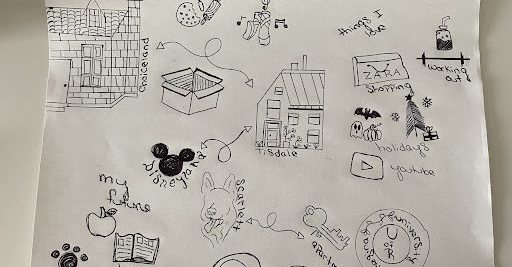
There are many places and enjoyments within my mapping project. These include the places I have lived in order, my hobbies and interests, the most important articles and items within my life currently, my favorite implements to my lifestyle, and what I hope my future has in store for me. Each symbol has a story that takes place within my map. The dog head is an outline of my canine bestie, Scarlett. I adopted/rescued her a week before I graduated grade twelve and she has not left my side since. The cookie, rolling pin, and whisk represent my love for baking. Whenever I had a bad day at school (when I was younger) or I did not feel in control of the world around me, I would always bake chocolate chip cookies. Since then I have learned how to make sugar cookies and professionally decorate them with royal icing while learning to create other baked delights such as pumpkin cheesecake roll, churro cheesecake, Reese bars, and confetti cookie sandwiches. Each symbol tells a story, which makes each strand unique.
Imagine:
Beginning with Treaty Education my map includes Treaty territory 6 (Choiceland and Tisdale) and Treaty territory 4 (Regina), while Choiceland is located 74 kilometers from James Smith Cree Nation and Tisdale is located 46 kilometers from Kinistin Saulteaux Nation. Both of these First Nations reserves are home to peoples who speak the Cree language.
Next, we will focus on Science. Choiceland and Tisdale alike are both located within the Boreal Plain Ecozone, whilst Regina is located within the Prarie Ecozone. The Boreal Ecozone differs from the Prarie Ecozone as it houses thick layers of soil, poor nutrients, vast forest, and a cool climate. This ecozone is also home to black bears, wolves, lynx, moose, caribou, and white-tail deer (all of which have lived in the forest on our acreage for the entirety of my life so far). Rather, the Plain Ecozone has grand economical resources such as coal, potash, and aggregates while lacking in natural vegetation. For animals, this ecozone is the home to cranes, bison, loons, and bluebirds (much more peaceful I would say).
Lastly, we will focus on English Language Arts for this section. When I was a wee lassie I loved to play outside and allow for my imagination to run wild. I had everything I needed, always. Where you would see a tree, I would see a castle. Where you would see a crooked trail in the trees, I would see an adventure. Where you would see a trampoline, I would see the ability to fly. One day in the fall me and my best sidekick (my pup Molly) decided to explore a whole new trail in the woods on our acreage. We owned acres of land, so as a twelve-year-old this was my oasis. After deciding to go off of the beaten path Molly and I came across the skull of a cow. Never had we owned cows on this land, so I knew it had to be placed there. Once I found it I knew that it was a treasure, so every day Molly and I would go back to the cow skull, enjoying every step it took us to get there. Upon asking my father about the skull we came to the conclusion that coyotes must have drug it there finding no use left for it as the flesh had either decomposed or been eaten. Even to this day, the cow skull resides in the exact same place in the forest. Now that Molly has passed away I know that she will always remember our adventures and remember our tiny piece of treasure. Where you would see a cow skull, Molly and I see treasure.
Reflect:
For the reflection portion of this assignment, I will be focusing on where I am currently residing, Regina. There are many pieces of Indigenous artworks displayed within the city of Regina. These pieces can be found at the following locations: Sâkêwêwak First Nations Artist Collective Inc, the MacKenzie Art Gallery, and the Traditions Hand Craft Gallery. Over just the month of September alone Regina is hosting many events to represent and host the voices of Indigenous peoples in our community. Some of these events include the Regina Public Library Films The Foreigners Home which is an exhibit based on Indigenous Stories and communities, as well as an Indigenous Students Networking event that allows for developing community and employment opportunities to Indigenous peoples within and around the city. The city of Regina is also taking part in the national day of Truth and Reconciliation. From a place of privilege, I can see how this may be an issue as well, as we should not need to create special events to recognize Indigenous peoples but rather put in the effort that makes them seen, heard, understood, and allows for opportunities every single day. Not just on special event days or exhibits being hosted. We are making a change, yes. However, not enough change has been created yet. As a community, we are making change, but as individuals, we need to make sure and allow ourselves time to attend these events and immerse ourselves in understanding Indigenous culture and ways of knowing.
Honour:
The learners within Regina are very diverse, not only in culture but in age and beliefs as well. Humans begin learning as soon as they are born, to eat and drink, to walking and talking, to writing and reading, to math and science, to responsibility and nurturing, and so on. This includes Regina as a community of learners as well. Regina is also home to Aboriginals (First Nation, Metis), Asian (South, SouthEast, East, West), Black, Arab, White, and Latin. Regina is also the fastest growing city within Canada on the diversity scale. Regina, as well as much of Saskatchewan, is very heavily influenced by Germany, Russia, Ukraine, France, Ireland, Scotland, as well as Indigenous cultures. Making the learners, very much so, diverse. There are many opportunities for learners (of any age) in Regina, Including employment, multi-level schooling, sports, art, support, and aid (health, wealth, homing). When it comes to barriers there may be language barriers between students and teachers or even students and other students. There can also be religious barriers as well as belief system differences. Through learning and growing as an education system there are proper steps in place within each school division on how to be the best school and place for students to be at all times no matter what difference any student may have.


 Sydney's Inquiries